
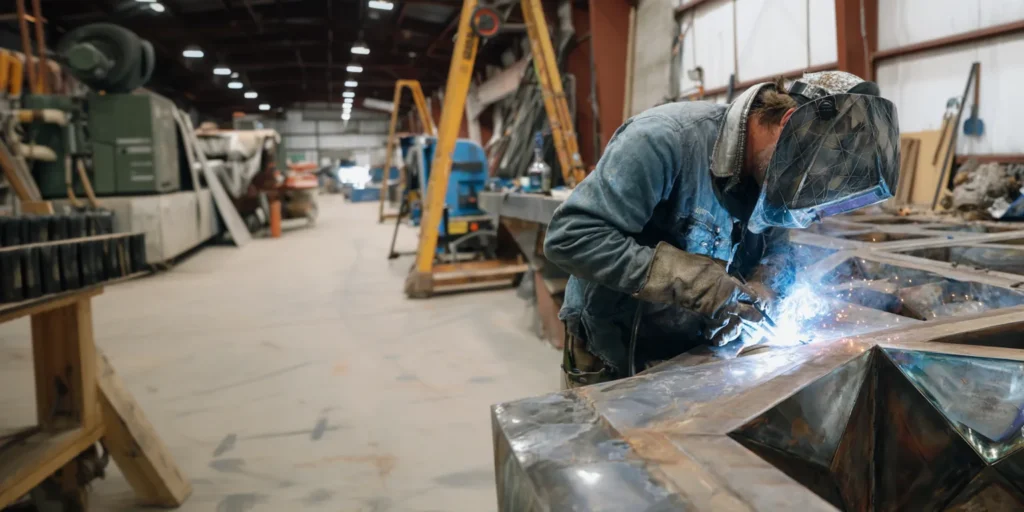
In the world of structural engineering, welding is the invisible force that holds our cities together. From bridges and buildings to custom steel frames, every joint matters — and choosing the right welding method can determine the strength, durability, and safety of the entire structure.
These welding processes are used throughout our custom metal fabrication services, including structural frames, industrial assemblies, platforms, supports, tanks, and project-specific steel components.
So, what are the four main types of welding, and where do they shine? Let’s break it down.
1. MIG Welding (Gas Metal Arc Welding)
MIG welding is the go-to method for many industrial and fabrication projects. It uses a continuous wire feed and shielding gas to create smooth, clean welds with minimal spatter.
Best for: structural steel frames, manufacturing, and high-speed production where efficiency matters.
Why it’s popular: easy to automate, consistent results, great for mild and stainless steel.
2. TIG Welding (Gas Tungsten Arc Welding)
When precision and aesthetics matter most, TIG welding leads the way. It requires more skill and control, but the results are strong, neat, and corrosion-resistant.
Best for: thin materials, stainless steel, aluminum, and detailed metalwork.
Why it’s used in structural engineering: produces clean, precise welds with excellent control and corrosion resistance, ideal for custom components and critical load points.
3. Stick Welding (Shielded Metal Arc Welding)
Stick welding is the rugged workhorse of the field. It’s versatile and reliable, performing well even in harsh outdoor conditions.
Best for: construction sites, repairs, and heavy steel structures.
Why engineers love it: it’s tough, portable, and doesn’t rely on external shielding gas — perfect for field welding.
4. Flux-Cored Arc Welding (FCAW)
Think of flux-cored welding as the MIG’s heavy-duty cousin. It uses a tubular wire filled with flux, allowing for deeper penetration and stronger welds.
Best for: thick materials, industrial projects, and structural components under high stress.
Why it matters: it’s efficient for large-scale construction and offers excellent weld quality in all positions.
Which Welding Process Produces the Strongest Weld?
No single welding process is always the strongest. Weld strength depends on the base material, material thickness, joint design, filler metal, welding procedure, environmental conditions, and the qualifications of the welder.
FCAW and SMAW are commonly used for heavy structural steel and field applications because they provide strong penetration and perform well on thick materials. GMAW offers efficient and consistent production welding, while GTAW provides precise control for stainless steel, aluminum, and critical detailed components.
The correct process must be selected according to the project specifications, engineering requirements, and applicable welding standards.
Certified Welding and Custom Metal Fabrication
At 3D Mechanical, our certified welders use GTAW, SMAW, GMAW, and FCAW processes for carbon steel, stainless steel, and aluminum projects.
We provide structural welding services and custom metal fabrication for industrial, infrastructure, manufacturing, water treatment, utility, and OEM applications across Ontario and North America.
Whether your project involves a new structure, industrial equipment frame, welded assembly, retrofit, or custom component, our team can select the appropriate welding process based on the material, design requirements, and operating environment.