
Choosing between industrial metal fabricators for a large-scale project involves more than comparing prices. The right fabrication partner must have the facility, equipment, qualified personnel, certifications and project-management capabilities required to manufacture complex components safely, accurately and on schedule.
A company that is well suited to small custom jobs may not have the lifting capacity, production space or quality-control systems needed for multi-ton assemblies, structural components or repeat production work.
When evaluating industrial metal fabricators, project owners, engineers, OEMs and contractors should consider the complete capabilities of each company—not only whether it can cut and weld metal.
The following factors can help you select a fabrication partner capable of supporting a demanding, large-scale project.
3D Mechanical provides industrial metal fabrication services for manufacturers, OEMs, infrastructure contractors, utilities, and water treatment facilities across Ontario and North America.
1. Relevant Industrial Fabrication Experience
Experience should be evaluated according to the type and scale of work the fabricator has completed.
A company may have decades of general welding experience but limited exposure to engineered industrial projects. Ask whether the fabricator has completed work involving similar materials, dimensions, operating conditions and quality requirements.
Relevant experience may include:
- Structural frames and support systems
- Industrial equipment frames
- Large welded assemblies
- Tanks and process components
- Platforms, walkways and access systems
- Utility and energy infrastructure
- Water and wastewater treatment equipment
- Manufacturing and processing systems
- OEM components and repeat production runs
The best fabrication partner does not necessarily need to have produced the exact same component before. However, its team should understand the technical, scheduling and logistical challenges associated with comparable industrial work.
Industry-specific experience can also reduce the amount of time required to explain common project requirements. A fabricator familiar with water treatment facilities, for example, may already understand the importance of corrosion resistance, access requirements and coordination with piping and processing equipment.
2. Facility Size and Available Production Space
Facility size can have a direct effect on whether a project can be assembled efficiently.
Large components may require substantial floor space for layout, fit-up, welding, inspection and preparation for shipping. The fabricator may also need space to store raw materials and completed assemblies without disrupting other active projects.
When comparing custom metal fabricators in Ontario, ask:
- Is there enough indoor space for the complete assembly?
- Can multiple project stages be completed without repeatedly moving the work?
- Is outdoor storage available when required?
- Can trucks and trailers access the loading area?
- Can the facility accommodate both one-off builds and production work?
- Will the project compete for space with other active jobs?
A larger facility alone does not guarantee better results. The space should be organized to support safe material flow, efficient production and proper separation between fabrication stages.
3. Lifting and Material-Handling Capacity
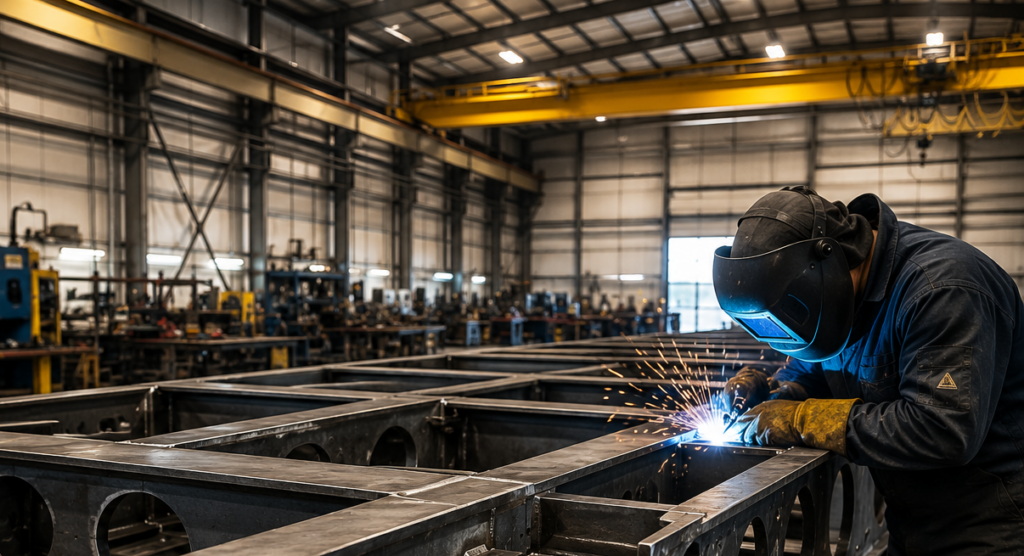
Heavy industrial fabrication requires more than adequate floor space. The fabricator must be able to safely move raw material, rotate assemblies during welding and load completed components for delivery.
Overhead cranes are particularly important for large-scale projects. They allow teams to position heavy components accurately while reducing reliance on manual handling or repeated forklift movements.
Before selecting a fabricator, confirm:
- The capacity of its overhead cranes
- Whether cranes cover the necessary production areas
- The number and capacity of available forklifts
- Maximum component dimensions and weights
- Available loading and unloading equipment
- Access for flatbed trucks and specialized transportation
- Whether lifting plans are developed for unusual assemblies
The required capacity should be evaluated against both the final weight of the assembly and the weight of individual components during fabrication. A project may also require an assembly to be rotated several times for welding, inspection or finishing.
4. CWB Certification and Qualified Welding Personnel
For many structural, municipal, infrastructure and industrial projects in Canada, welding must be performed by a company certified to the applicable Canadian requirements.
CWB company certification involves more than an individual welder holding a ticket. Under CSA W47.1, certified companies must have qualified welding personnel and supervisors, maintain approved welding procedures and satisfy ongoing certification requirements. The CWB Group also provides third-party verification of compliance.
When evaluating a potential partner, ask:
- Which CSA standards is the company certified to?
- Does the certification cover the material involved in your project?
- Are the required welding processes supported?
- Are the welders qualified for the required procedures and positions?
- Is a qualified welding supervisor available?
- Can the company provide a current CWB Letter of Validation?
- Can it coordinate third-party inspection or NDE testing when required?
The CWB recommends verifying both the status and scope of a company’s certification rather than relying solely on welder tickets, certificates displayed on a wall or general certification claims.
Certification does not replace project-specific inspection, but it provides an important foundation for consistent welding procedures, personnel qualifications and quality control.
5. Experience With the Required Materials
The selected fabricator should have proven experience with the materials specified for the project.
Common industrial fabrication materials include:
Carbon Steel
Carbon steel is frequently used for structural supports, equipment frames, platforms and heavy welded assemblies. It offers strength, versatility and cost efficiency, but may require coatings or other corrosion-protection measures depending on the operating environment.
Stainless Steel
Stainless steel is commonly selected for water treatment, processing and other corrosion-sensitive applications. Fabrication requires appropriate procedures and careful material handling to help prevent contamination and preserve corrosion resistance.
Aluminum
Aluminum provides a strong, lightweight and corrosion-resistant option for selected industrial and structural applications. However, its thermal properties and welding requirements differ from carbon steel.
A fabricator should understand how the selected material affects:
- Welding procedures
- Heat input and distortion
- Cutting and forming methods
- Surface preparation
- Contamination control
- Finishing requirements
- Inspection and testing
- Long-term performance
If a project combines different metals, the team should also understand how to manage material separation, joining requirements and compatibility.
6. Ability to Work From Engineered Drawings
Large industrial projects are normally manufactured from engineered drawings, models and detailed specifications.
The fabricator must be able to interpret this information accurately before production begins. Its estimating, project-management and shop teams should identify missing dimensions, conflicting details, unusual tolerances and potential fabrication challenges early in the process.
Before awarding the work, determine whether the fabricator can review:
- Issued-for-fabrication drawings
- General arrangement drawings
- Weld symbols and specifications
- Material requirements
- Bills of materials
- Tolerance requirements
- Inspection and testing plans
- Finishing specifications
- Shipping and installation constraints
A capable fabrication partner should ask technical questions before work begins. Clarifying an issue during the drawing-review stage is usually less costly than correcting it after material has been cut or an assembly has been welded.
For complex projects, confirm how drawing revisions and change orders will be documented and communicated to the shop.
7. Quality-Control and Inspection Processes
Quality control should be built into the fabrication process rather than treated as a final step.
Ask each prospective fabricator how it verifies:
- Incoming materials
- Material grades and identification
- Dimensions and tolerances
- Fit-up before welding
- Welder and procedure qualifications
- Weld quality
- Final assembly dimensions
- Surface preparation and finishing
- Required project documentation
Depending on the project, additional testing may include:
- Visual weld inspection
- Magnetic particle testing
- Liquid penetrant testing
- Ultrasonic testing
- Radiographic testing
- Dimensional inspection
- Coating inspection
The specific inspection plan should be based on the drawings, governing standards and customer requirements.
When comparing steel fabricators in Ontario, ask whether inspections are performed in-house, through qualified third parties or through a combination of both. You should also establish which documents will be provided when the project is complete.
8. Production Capacity and Project Scheduling
A fabricator may have the technical ability to complete a project but lack the available production capacity to meet the required schedule.
During the quotation stage, discuss:
- Required delivery dates
- Material lead times
- Drawing-review deadlines
- Production milestones
- Inspection hold points
- Finishing and coating lead times
- Transportation requirements
- Potential schedule risks
Ask how the fabricator manages multiple active projects and whether it has enough qualified personnel and equipment to support your schedule.
For repeat production, determine whether the company can maintain consistent output over multiple units or production runs. Fixtures, documented processes and repeatable inspection methods may be needed to maintain dimensional consistency.
A reliable partner should provide a realistic schedule rather than an aggressive date that does not account for material procurement, inspections, finishing or transportation.
9. Shipping Large Fabricated Assemblies
The project is not complete when fabrication ends. Large assemblies must be packaged, loaded and transported safely to the job site or customer facility.
Shipping should be considered during the design and fabrication stages, particularly when components approach transportation limits.
Important considerations include:
- Overall dimensions and weight
- Truck and trailer requirements
- Oversized-load restrictions
- Lifting and tie-down points
- Protection of finished surfaces
- Temporary bracing
- Shipping orientation
- Delivery sequence
- Site access
- Unloading requirements
In some cases, an assembly may need to be divided into transportable sections and designed for efficient field installation. The fabricator should coordinate these requirements with the customer, engineer, transportation provider and installation team.
A company experienced in large-scale metal fabrication should be able to identify logistical concerns before they affect the delivery date.
10. Experience Within Your Industry
Different industries place different demands on fabricated components.
Manufacturing projects may prioritize tight tolerances, repeatable production and compatibility with existing equipment. Water treatment applications may require corrosion-resistant materials and coordinated access systems. Infrastructure and utility projects may involve certified structural welding, extensive documentation and challenging delivery locations.
Look for a fabrication company that understands the priorities of your sector, including:
- Manufacturing and industrial processing
- Water and wastewater treatment
- Infrastructure and construction
- Utilities and energy
- OEM production
- Municipal projects
Relevant industry experience helps the fabricator anticipate risks that may not be immediately visible in the drawings.
Questions to Ask Before Selecting a Fabricator
Before awarding a large industrial project, ask each potential fabrication partner:
- Have you completed projects of a similar size and complexity?
- What are the dimensions of your fabrication facility?
- What is your maximum lifting and material-handling capacity?
- Which materials and welding processes do you regularly work with?
- Which CWB certifications do you currently hold?
- How do you review engineered drawings before fabrication?
- What quality-control and inspection processes will apply?
- Can you coordinate third-party testing when required?
- What production capacity is available for our schedule?
- How will the completed assemblies be loaded and delivered?
- What project documentation will be supplied?
- Who will manage communication and technical questions throughout the project?
Clear answers to these questions can reveal whether a company is prepared to act as a true industrial fabrication partner.
Industrial Metal Fabrication Capabilities at 3D Mechanical
3D Mechanical supports industrial, manufacturing, infrastructure, water treatment, utility and OEM projects across Ontario and North America.
Its Brantford fabrication facility provides approximately 15,000 square feet of production space, two 10-ton overhead cranes, indoor and outdoor material-handling equipment and a fenced outdoor yard. The company works with carbon steel, stainless steel and aluminum and provides CWB-certified welding and custom fabrication for engineered industrial projects.
Projects can include structural frames, equipment supports, welded assemblies, platforms, tanks, process components and other custom-fabricated systems. Inspection, NDE testing, finishing and transportation support can also be coordinated according to project requirements.
Learn more about 3D Mechanical’s industrial metal fabrication services or submit your drawings and specifications for project review.
Choose a Fabricator Based on the Complete Project
Price is an important consideration, but it should not be the only factor used to select a fabrication company.
The right partner must have the facility, lifting capacity, certified personnel, material experience, quality controls and production availability needed to complete the entire project successfully.
By carefully comparing industrial metal fabricators before issuing a purchase order, project teams can reduce production risks, improve communication and increase the likelihood that the finished assemblies will arrive on time and meet the required specifications.